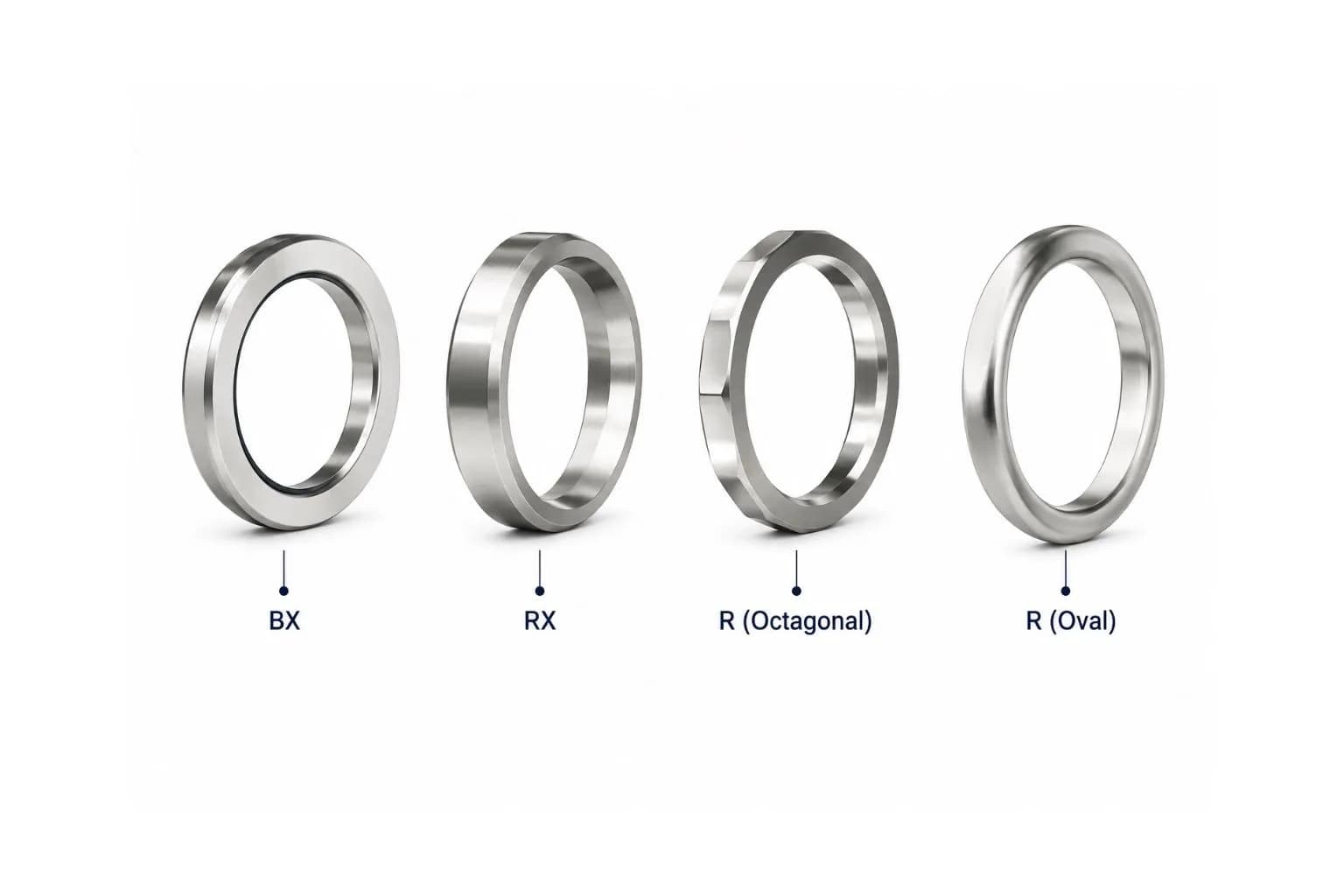
Oval, Octagonal, RX, and BX profiles
The Oval Ring Joint gasket seals on a curved contact surface and is common on older RTJ flange designs. The Octagonal Ring Joint gasket seals on angled faces and is the preferred profile for most modern ASME RTJ flanges.
RX ring joint gaskets are pressure-energised profiles used on many API flanges. BX ring joint gaskets are used on high-pressure API 6A wellhead and Christmas tree connections. Profile selection is driven by the flange groove design, not preference.
- Oval Ring Joint — older flange designs
- Octagonal Ring Joint — modern ASME RTJ flanges
- RX Ring Joint — API pressure-energised service
- BX Ring Joint — high-pressure API 6A connections
How RTJ gasket dimensions are specified
RTJ gasket dimensions are usually identified by an R-number (or RX/BX designation) that maps to a specific pitch diameter, width, and height in ASME B16.20 or API 6A. Ordering by flange size alone is not enough — the ring number must match the groove.
If you do not have the ring number, share the flange standard, nominal size, pressure class, and groove type. We will confirm the correct RTJ gasket dimensions before machining.
Materials and hardness control
RTJ rings are machined from soft iron, low carbon steel, SS 304, SS 316, Inconel, Monel, and other certified metals. Hardness is controlled so the ring yields before the flange groove — protecting expensive equipment while still achieving a metal-to-metal seal.
High-pressure gasket service
RTJ gaskets are the standard high-pressure gasket choice for critical oil & gas and refinery flanges. When pressure class, groove type, and ring hardness are matched correctly, the joint delivers reliable metal-to-metal sealing under cycling loads.