What defines a spiral wound gasket specification
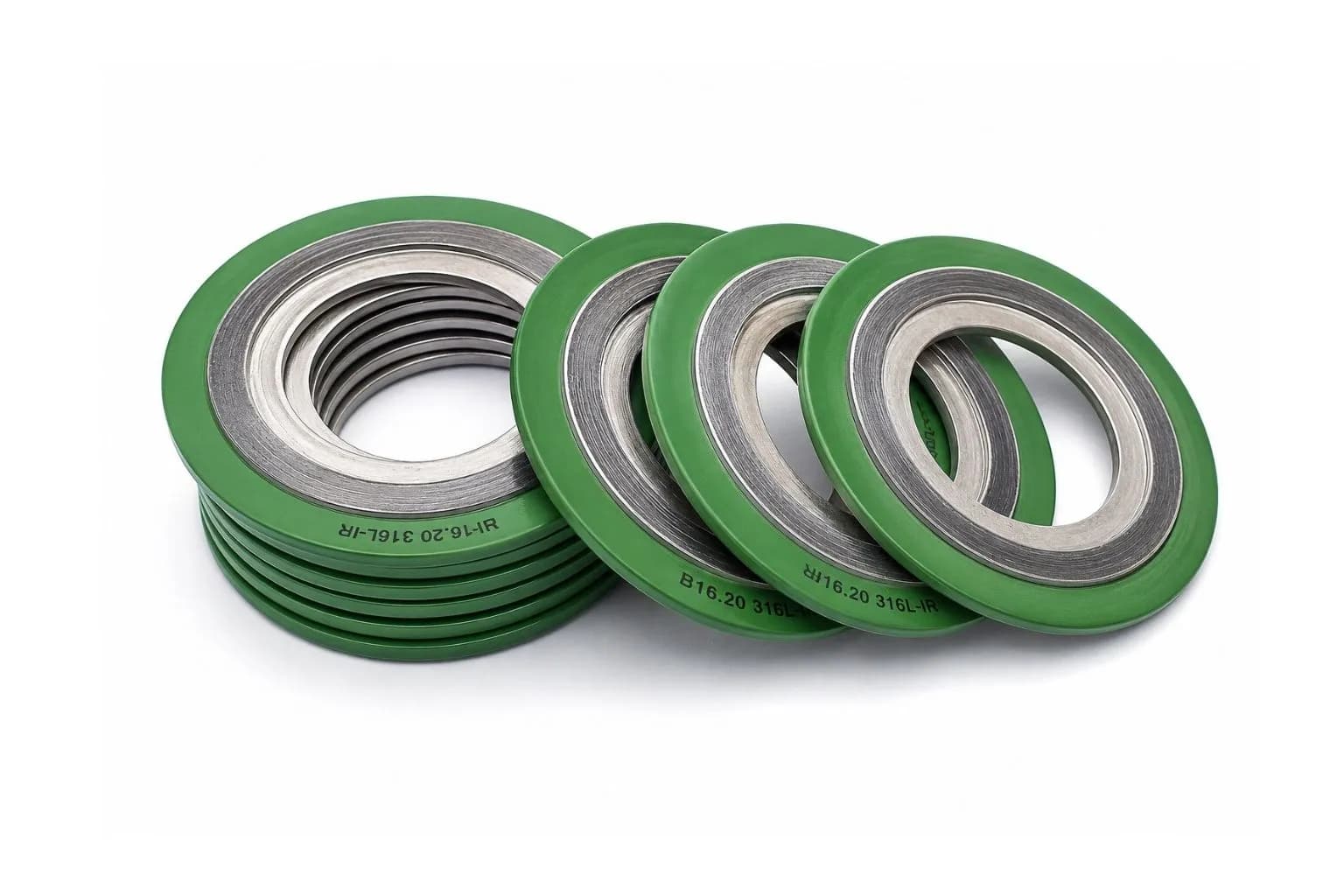
A spiral wound gasket is specified by more than outer diameter. The complete specification covers flange standard and size, pressure class, winding metal, filler material, and whether an inner ring, outer ring, or both are required.
ASME B16.20 is the primary dimensional standard for spiral wound metallic gaskets used on ASME B16.5 and B16.47 flanges. When your flange drawing differs from these standards, we manufacture to the drawing instead of forcing a catalogue size.
Spiral wound gasket dimensions
Standard spiral wound gasket dimensions follow the flange nominal size and pressure class. Outer diameter, inner diameter, and sealing-element width are matched so the gasket seats correctly between the flange faces without protruding into the bore or hanging outside the raised face.
Custom dimensions are common on heat exchangers, vessels, and non-standard equipment. Share the flange OD, ID, raised-face diameter, and bolt-circle data — or a sample — and we reverse-engineer the correct spiral wound gasket dimensions.
- ASME B16.5 / B16.47 standard sizes
- Custom diameters for exchangers and vessels
- Inner and outer ring configurations
- Pressure classes typically 150# to 2500#
Graphite, PTFE, and CAF fillers
Graphite spiral wound gaskets are the default for high-temperature steam and hydrocarbon service because flexible graphite recovers well under thermal cycling.
PTFE spiral wound gaskets are preferred for aggressive chemicals and high-purity media where metal contamination or chemical attack is a concern. CAF (compressed asbestos-free) fillers cover general-purpose utility service where graphite or PTFE performance is not required.
Metal windings — SS 304, SS 316, and alloys
The metal winding strip forms the structural backbone of a spiral wound metallic gasket. SS 304 covers most general industrial service. SS 316 is specified when chlorides or more aggressive chemicals are present. Inconel, Monel, and other alloys are used for severe temperature or corrosion duties.
How to order the correct spiral wound gasket
Send flange size and standard, pressure class, process medium, temperature, and preferred filler. If you already have a part number or sample, include that too. Kemicon manufactures to ASME B16.20 with Material Test Reports on every order.