Quick summary
- A spiral wound gasket combines a metal strip with a soft filler in a spiral pattern.
- The inner ring prevents buckling; the outer ring centres the gasket and limits compression.
- Correct specification - pressure class, temperature, and medium - prevents most failures.
If you work anywhere near flanged piping - oil and gas, power generation, chemical processing - you have almost certainly handled a spiral wound gasket. Most people never stop to ask what is actually happening inside that thin metal ring, or why picking the wrong one can shut a plant down for a day.
This short primer covers the basics. For a full selection guide covering types, materials, applications, and standards, see our Complete Guide to Spiral Wound Gaskets.
What is a spiral wound gasket?
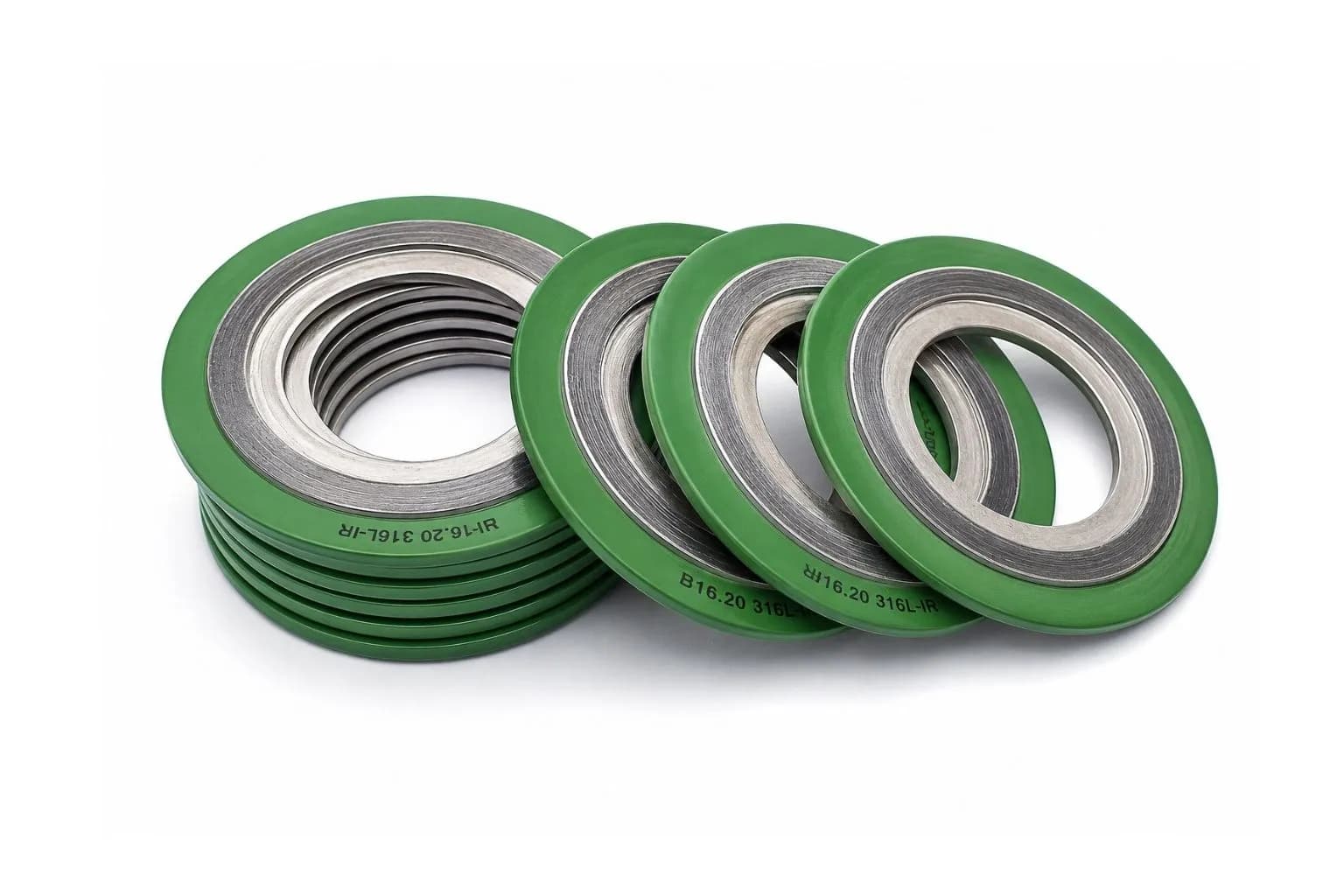
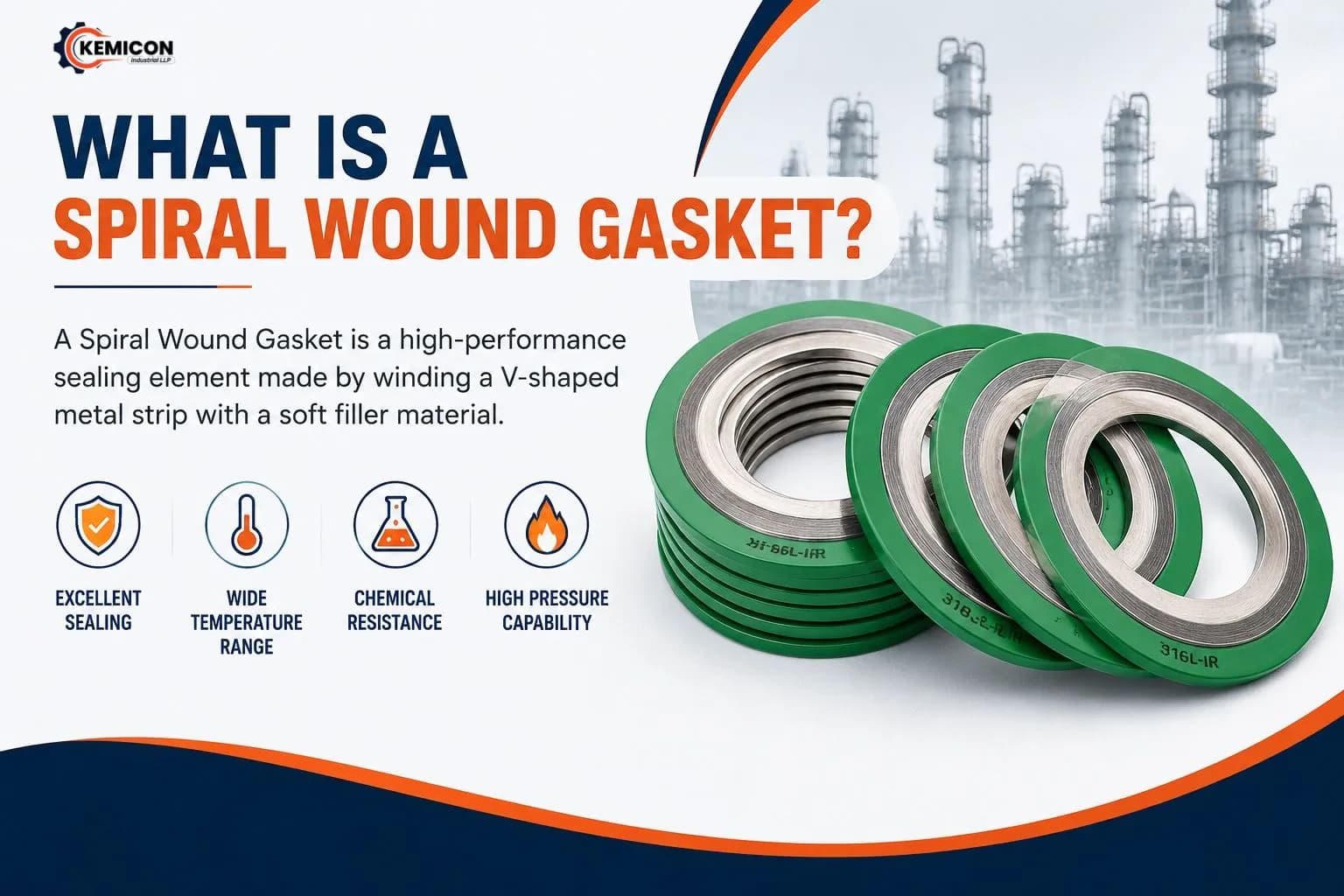
A spiral wound gasket is a semi-metallic seal placed between two pipe flanges to stop fluid or gas from escaping under pressure and heat. It gets its name from how it is made: a thin, V-shaped metal strip is wound together with a soft filler material in a continuous spiral, layer after layer.
That combination is what makes the design work so well. The metal strip gives the gasket the strength to hold its shape and resist blowout. The soft filler flows into the tiny surface imperfections on the flange face and seals them. Neither material alone would do the job as well as the two do together.
The three parts every spiral wound gasket is built from
Pull one apart (carefully) and you will find three distinct parts, each doing a different job.
- Winding - the alternating metal strip and filler layers that form the sealing element itself.
- Inner ring - a solid metal ring fitted inside the winding. It stops the gasket from buckling inward under pressure and protects the winding from turbulent flow in the line.
- Outer ring, also called the centering ring - a flat metal ring around the outside that keeps the gasket centred on the flange bore and stops the bolts from over-compressing the winding.
What spiral wound gaskets are made from
The metal strip and the filler are chosen separately, based on what the gasket needs to survive. The metal strip is usually 304 or 316 stainless steel for general service, moving up to 321 stainless, Inconel, Monel, or Hastelloy when corrosion resistance or extreme temperature is a concern.
The filler is what actually does the sealing, and flexible graphite is the most common choice by far. It handles temperatures up to around 450°C, recovers well after thermal cycling, and works with most oils, gases, and hydrocarbons. PTFE is the go-to filler when the process fluid is aggressive or corrosive, since it resists almost every chemical you are likely to encounter. Ceramic and mica fillers cover the rarer, extreme-heat applications.
- Metal strip: 304 SS, 316 SS, 321 SS, Inconel, Monel, Hastelloy
- Filler: flexible graphite (most common), PTFE, ceramic, mica
- Outer ring colour: coded to ASME standards, so you can identify the grade at a glance on the shop floor
Where spiral wound gaskets are actually used
You will find spiral wound gaskets anywhere a standard flat gasket cannot handle the pressure or temperature involved. In practice, that usually means ASME pressure class 300# and above, or any service where the operating temperature rules out ordinary rubber or fibre gaskets.
- Oil and gas - pipelines, refineries, wellheads
- Power generation - steam turbines, boilers, heat exchangers
- Chemical processing - reactors, pressure vessels, process lines
- Pharmaceuticals - PTFE-filled gaskets for high-purity requirements
How to specify a spiral wound gasket without guesswork
Most gasket failures trace back to a specification mistake, not a manufacturing defect. Before you place an order, make sure the following details are confirmed and written down.
- Flange standard and pressure class (for example, ASME B16.20 with a 150# to 2500# rating)
- Pipe size, expressed as nominal pipe size (NPS)
- Operating pressure and temperature the joint will actually see
- The process medium - the exact fluid or gas being sealed
- Material certification requirements, such as EN 10204 3.1 or NACE MR0175
Why the manufacturer matters more than the price tag
Two spiral wound gaskets can look identical and perform very differently. Winding density, filler consistency, and ring flatness all affect how well a gasket seals, and none of that is visible once the flange is bolted up.
A gasket that costs a little less but fails in service ends up costing far more in downtime, rework, and, in the worst case, a safety incident. That is why it is worth insisting on a manufacturer that documents its quality process and provides a Material Test Report (MTR) with every order, rather than choosing on unit price alone.
We manufacture spiral wound gaskets to ASME B16.20 with full material traceability, in both standard sizes and custom configurations. If you are working out the right specification for your application, our engineering team is glad to help.
Quick recommendations
- Standard piping, 300# and aboveSpiral Wound Gasket
- High-purity or pharma servicePTFE-filled Spiral Wound
- Steam and hot hydrocarbonsGraphite-filled Spiral Wound
Frequently asked questions
What is a spiral wound gasket used for?
What materials go into a spiral wound gasket?
Can a spiral wound gasket be reused after the flange is opened?
What is the difference between the inner ring and outer ring?
What standard governs spiral wound gasket dimensions?
Still unsure which specification fits?
Talk to our gasket engineer. Share medium, temperature, pressure class, and flange standard - we will recommend the right construction.