Quick summary
- A spiral wound gasket combines a metal winding with a soft filler for strength and sealability.
- Style CG (outer ring) suits most raised-face flanges; Style CGI adds an inner ring for critical service.
- Match filler to temperature and medium — graphite for heat/steam, PTFE for chemicals and pharma.
- Always replace gaskets after opening a flange; never reuse in critical or high-pressure service.
Industrial piping systems operate under extreme pressure, high temperatures, and aggressive chemicals. Specify the wrong seal and you risk costly downtime, product loss, and serious safety incidents.
The spiral wound gasket is one of the most trusted semi-metallic seals in oil and gas, petrochemical, power, and process plants worldwide. Built for demanding service, it maintains a reliable seal across thermal cycling, vibration, and flange movement — when the metal grade, filler, and gasket type are matched to the job.
This guide covers spiral wound gasket construction, component materials, gasket types, real-world applications, applicable standards, and a practical selection checklist so procurement and maintenance engineers can specify with confidence.
What is a spiral wound gasket?
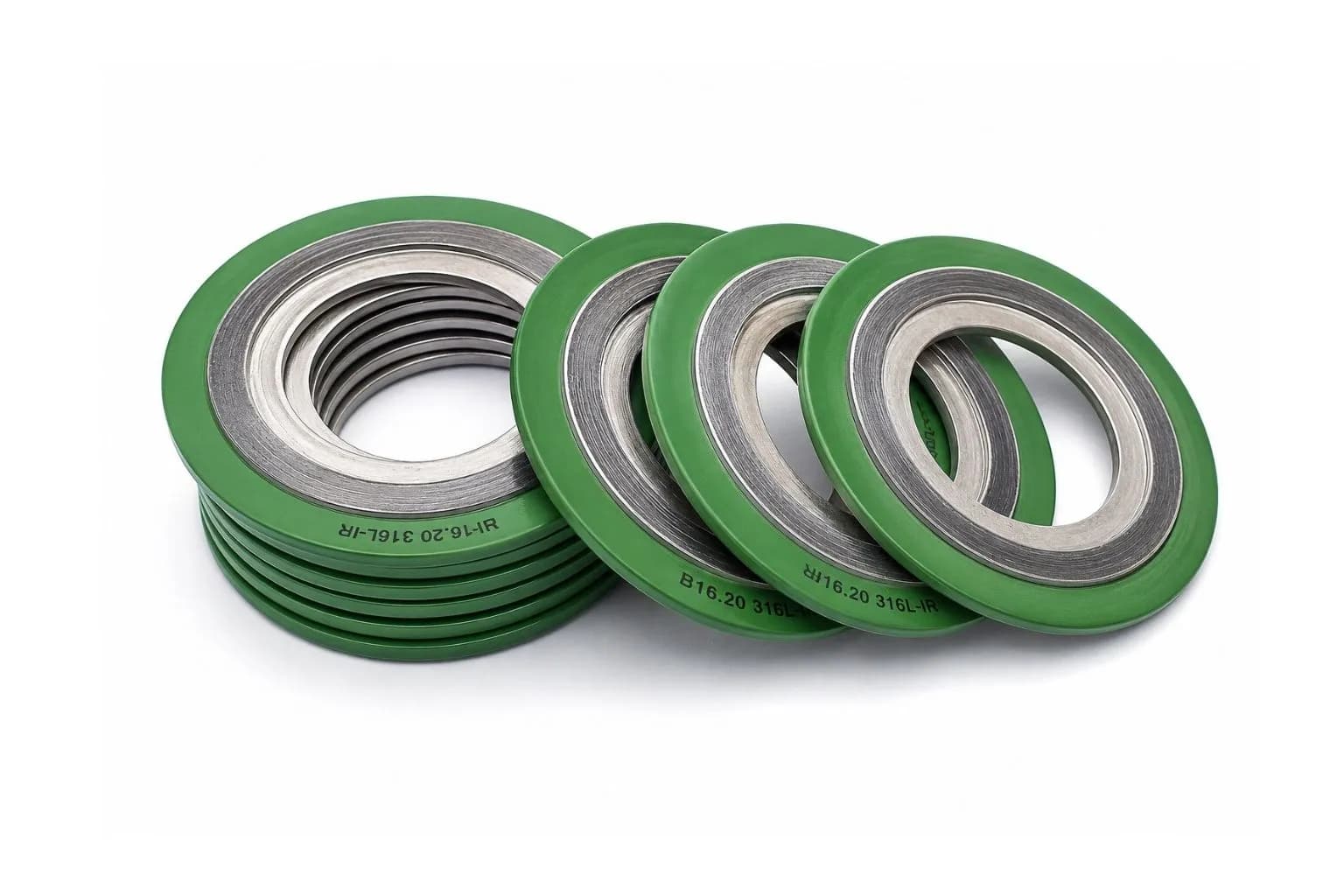
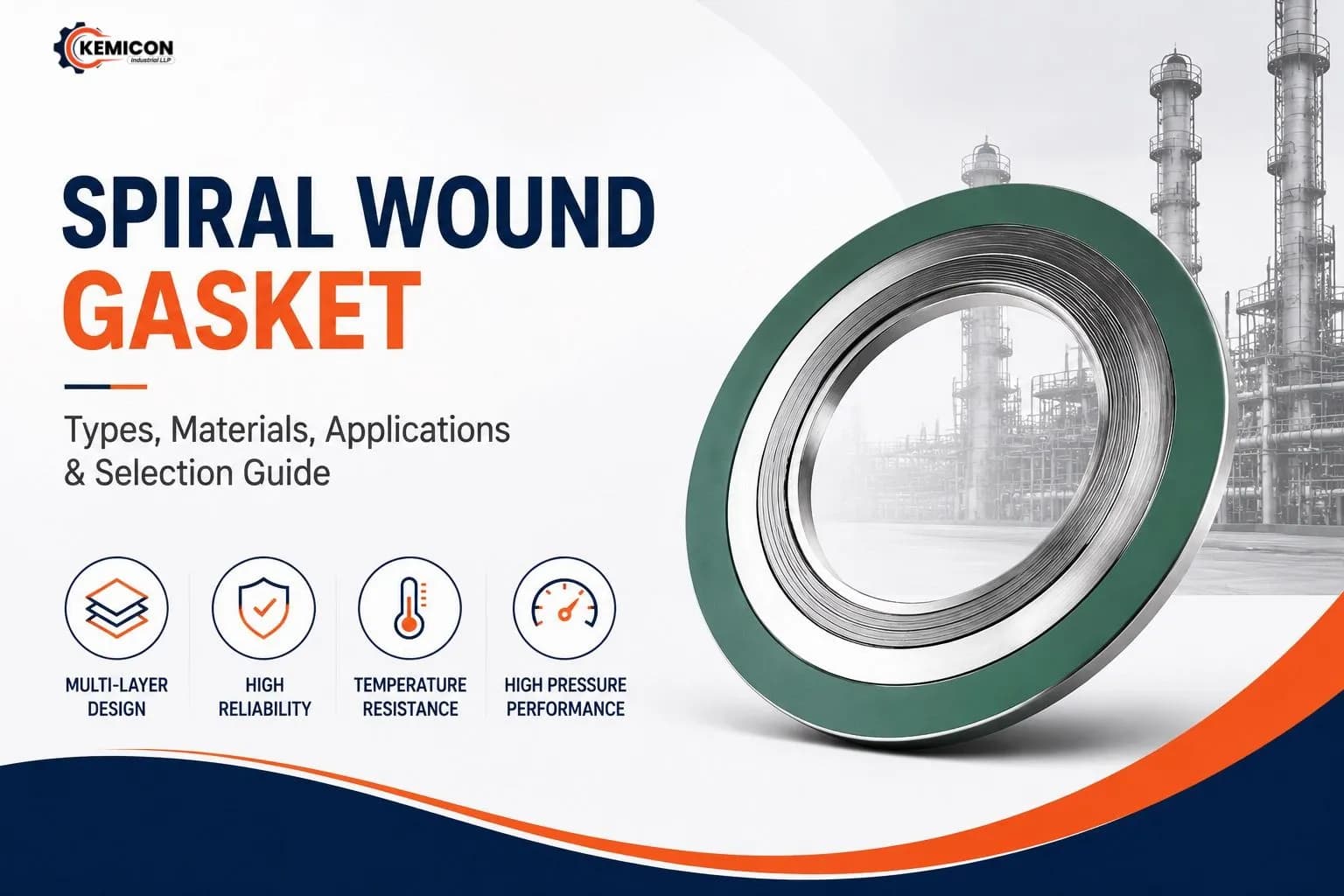
A spiral wound gasket is a semi-metallic seal manufactured by winding a thin V-shaped metal strip together with a soft filler material in a continuous spiral. The metal provides structural strength and blowout resistance; the filler flows into microscopic flange surface imperfections to create the actual seal.
Unlike conventional sheet gaskets, a spiral wound metallic gasket accommodates flange movement, thermal expansion, and vibration while maintaining sealing integrity across a wide pressure and temperature range. That combination of strength and flexibility is why it remains the default choice for ASME B16.5 and B16.47 flanged joints in 300# class and above.
How does a spiral wound gasket work?
When the gasket is compressed between two flanges, alternating layers of metal winding and soft filler work together. The metal strip holds the gasket geometry and resists internal pressure. The filler deforms into surface irregularities on the flange face, closing leak paths that a rigid metal seal alone cannot reach.
Under thermal cycling, the filler recovers between hot and cold cycles while the metal winding maintains overall shape. This dual behaviour makes spiral gaskets suitable for both low-temperature cryogenic service and high-temperature steam or hydrocarbon lines — provided the correct metal and filler grades are specified.
Main components of a spiral wound gasket
Every spiral wound gasket combines a sealing winding with one or two metal rings, depending on the service class and flange type. Understanding each part helps you specify the correct configuration the first time.
- Metal winding — alternating layers of metal strip and filler that form the primary sealing element
- Inner ring — solid metal ring inside the winding that prevents inward buckling under pressure
- Outer guide ring (centering ring) — locates the gasket on the flange bore, limits over-compression, and improves handling during installation
Metal winding materials
The metal strip determines mechanical strength, corrosion resistance, and maximum service temperature. Match the metal grade to the process medium and environment — not just the flange material.
- Stainless Steel 304 — general industrial service; the most common winding grade
- Stainless Steel 316 — chloride and chemically aggressive environments
- Carbon Steel — lower-cost service where corrosion is not a concern
- Monel — hydrofluoric acid and seawater applications
- Inconel — extreme temperature and severe corrosion duty
- Duplex Stainless Steel — high strength with improved chloride resistance
- Hastelloy — highly corrosive chemical and acid service
Filler materials
The filler creates the seal. Selecting the wrong grade is one of the most common — and most avoidable — causes of gasket failure. Always match filler to operating temperature, pressure class, and chemical compatibility.
- Flexible Graphite — high temperature, steam, hydrocarbons, and thermal cycling (most common filler)
- PTFE (Teflon) — aggressive chemicals, high purity, food, and pharmaceutical service
- Ceramic — extreme high-temperature applications beyond graphite limits
- Mica — additional high-temperature and fire-safe configurations
Types of spiral wound gaskets
Spiral wound gasket types differ by the presence of inner and outer rings. The correct type depends on flange facing, pressure class, and whether the joint is standard raised-face or a special groove configuration.
- Style CG (outer ring only) — the most common type for raised-face flanges in standard industrial piping
- Style RIR (inner ring only) — high-pressure and high-temperature service where inward buckling is a concern
- Style CGI (inner and outer ring) — maximum reliability for critical applications; widely specified in refineries and petrochemical plants
- Style R (basic, no rings) — tongue-and-groove or male-and-female flange configurations only
Advantages of spiral wound gaskets
Spiral wound gaskets have been the workhorse of industrial flange sealing for decades because they solve problems that flat gaskets cannot. Key performance advantages include:
- Excellent sealing performance across a wide pressure and temperature range
- High resistance to blowout compared with non-metallic sheet gaskets
- Strong recovery under thermal cycling and flange movement
- Resistant to vibration in rotating equipment and long pipeline runs
- Long service life when correctly specified and installed
- Available in standard ASME sizes and fully custom dimensions
- Suitable for aggressive chemicals when paired with the correct filler
- Straightforward installation with no special tooling required
Common spiral wound gasket applications
Spiral wound gaskets are specified wherever flat fibre or rubber gaskets cannot handle the operating conditions. Typical spiral wound gasket applications include:
- Oil and gas — pipelines, wellheads, refineries, and offshore platforms
- Petrochemical — reactors, crackers, and process transfer lines
- Chemical processing — pressure vessels, heat exchangers, and storage tanks
- Power generation — boilers, steam turbines, and condenser flanges
- Marine — engine room piping and cargo transfer systems
- Pharmaceutical — PTFE-filled gaskets for high-purity process lines
- Food processing — FDA-compliant PTFE filler for hygienic service
- Water treatment — high-pressure pump and valve flanges
Materials selection guide
Use this quick reference to match filler material to operating conditions. For borderline cases — mixed media, cycling duty, or uncertain temperature — share the full process data with your gasket supplier before ordering.
Industry standards for spiral wound gaskets
Quality spiral wound gaskets are manufactured to internationally recognised standards that govern dimensions, materials, marking, and quality requirements. The most relevant standards for industrial piping include:
- ASME B16.20 — primary standard for metallic gasket dimensions, materials, and marking
- ASME B16.5 — flange dimensions and pressure classes that pair with B16.20 gaskets
- ASME B16.47 — large-diameter flange series for NPS 26 and above
- API specifications — additional requirements for oil and gas service where applicable
- DIN and BS standards — European and British flange and gasket configurations
How to choose the right spiral wound gasket
Most flange leaks trace back to a specification error, not a manufacturing defect. Before placing an order, confirm every item on this checklist with your engineering team or gasket supplier.
- Operating pressure and pressure class (150# through 2500#)
- Operating temperature — minimum and maximum
- Process medium — exact fluid or gas, including concentration and contaminants
- Flange type and facing — raised face, ring joint, tongue-and-groove
- Flange finish — serrated, smooth, or damaged (affects filler choice)
- Available bolt load — limited bolt strength may require a different gasket style
- Pipe size (NPS) and flange standard (ASME, DIN, BS)
- Material certification — EN 10204 3.1 MTR, NACE MR0175, or project-specific requirements
Why specify a qualified spiral wound gasket manufacturer
Two spiral wound gaskets can look identical and perform very differently. Winding density, filler consistency, ring flatness, and metal grade traceability all affect long-term sealing — and none of that is visible once the flange is bolted up.
Kemicon Industrial LLP manufactures spiral wound gaskets to ASME B16.20 with premium raw materials, precision winding, strict in-process quality control, and full Material Test Reports on request. Standard catalogue sizes and fully custom dimensions are available, with technical support to help you match metal grade, filler, and gasket type to your application.
Whether you need a single replacement gasket or a project supply package, share your flange details, operating conditions, and certification requirements — our engineering team will confirm the correct specification before manufacture.
Quick recommendations
- Standard raised-face piping, 300#+Style CG — Graphite-filled
- Critical refinery / petrochemicalStyle CGI — Graphite-filled
- Aggressive chemical serviceStyle CG — PTFE-filled
- Pharma / food / high purityStyle CG — PTFE-filled
- Steam and hot hydrocarbonsStyle CG — Graphite-filled
Frequently asked questions
What is a spiral wound gasket used for?
What is the best filler material for a spiral wound gasket?
Can spiral wound gaskets be reused?
Which industries use spiral wound gaskets?
What standards do spiral wound gaskets follow?
What is the difference between a spiral wound gasket with and without rings?
Still unsure which specification fits?
Talk to our gasket engineer. Share medium, temperature, pressure class, and flange standard - we will recommend the right construction.