Quick summary
- RTJ gaskets create a metal-to-metal seal by deforming into a precision ring groove on RTJ flanges.
- Profile must match groove — R Oval, R Octagonal, RX, and BX are not interchangeable.
- Ring material must be softer than the flange groove so it yields and seals without damaging the groove.
- Replace RTJ gaskets after opening critical joints — do not reuse in high-pressure service.
In industries where equipment operates under extreme pressure and high temperature, even a small flange leak can cause costly downtime, safety incidents, and product loss. Oil and gas, petrochemical, offshore, power generation, and refinery operators rely on one of the most dependable metallic sealing solutions available — the RTJ gasket (Ring Type Joint Gasket).
Unlike conventional soft gaskets, an RTJ gasket creates a metal-to-metal seal by deforming into a precision-machined groove on RTJ flanges. That design delivers the sealing integrity critical applications demand.
This guide covers RTJ gasket construction, profile types, material grades, industry applications, applicable standards, selection criteria, and how RTJ gaskets compare with spiral wound alternatives — so engineers and procurement teams can specify with confidence.
What is an RTJ gasket?
A Ring Type Joint (RTJ) gasket is a precision-machined solid metal ring designed for high-pressure and high-temperature flange connections. Instead of compressing a soft filler, the ring deforms slightly into a matching groove machined into RTJ flanges, creating a secure metal-to-metal seal capable of withstanding severe operating conditions.
RTJ gaskets are specified wherever flange integrity and leak prevention are non-negotiable — wellhead equipment, refinery process lines, offshore platforms, LNG systems, and API-rated high-pressure valves.
- Oil and gas pipelines and wellhead assemblies
- Refineries and petrochemical process plants
- Offshore platforms and subsea equipment
- Power plants and high-pressure boilers
- Pressure vessels and API-rated equipment
How does an RTJ gasket work?
RTJ flanges contain specially machined ring grooves — oval or octagonal depending on the gasket profile. When flange bolts are tightened, the metal ring is compressed into the groove.
The gasket plastically deforms to fill microscopic imperfections in the groove surface, creating a high-integrity metal-to-metal seal. This sealing mechanism maintains reliability under severe pressure and temperature fluctuations, vibration, and thermal cycling — provided the correct profile, metal grade, and groove dimensions are matched.
Types of RTJ gaskets
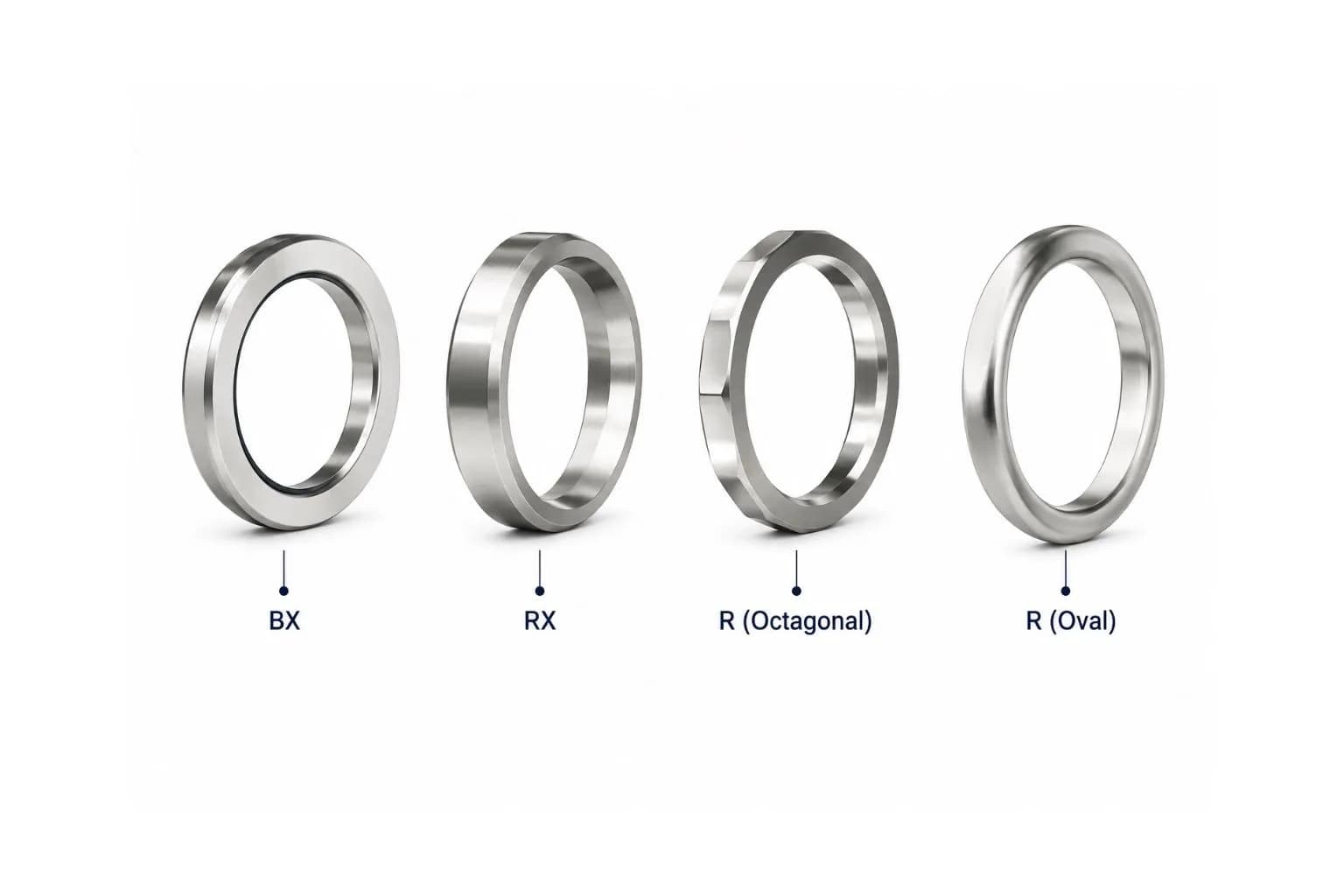
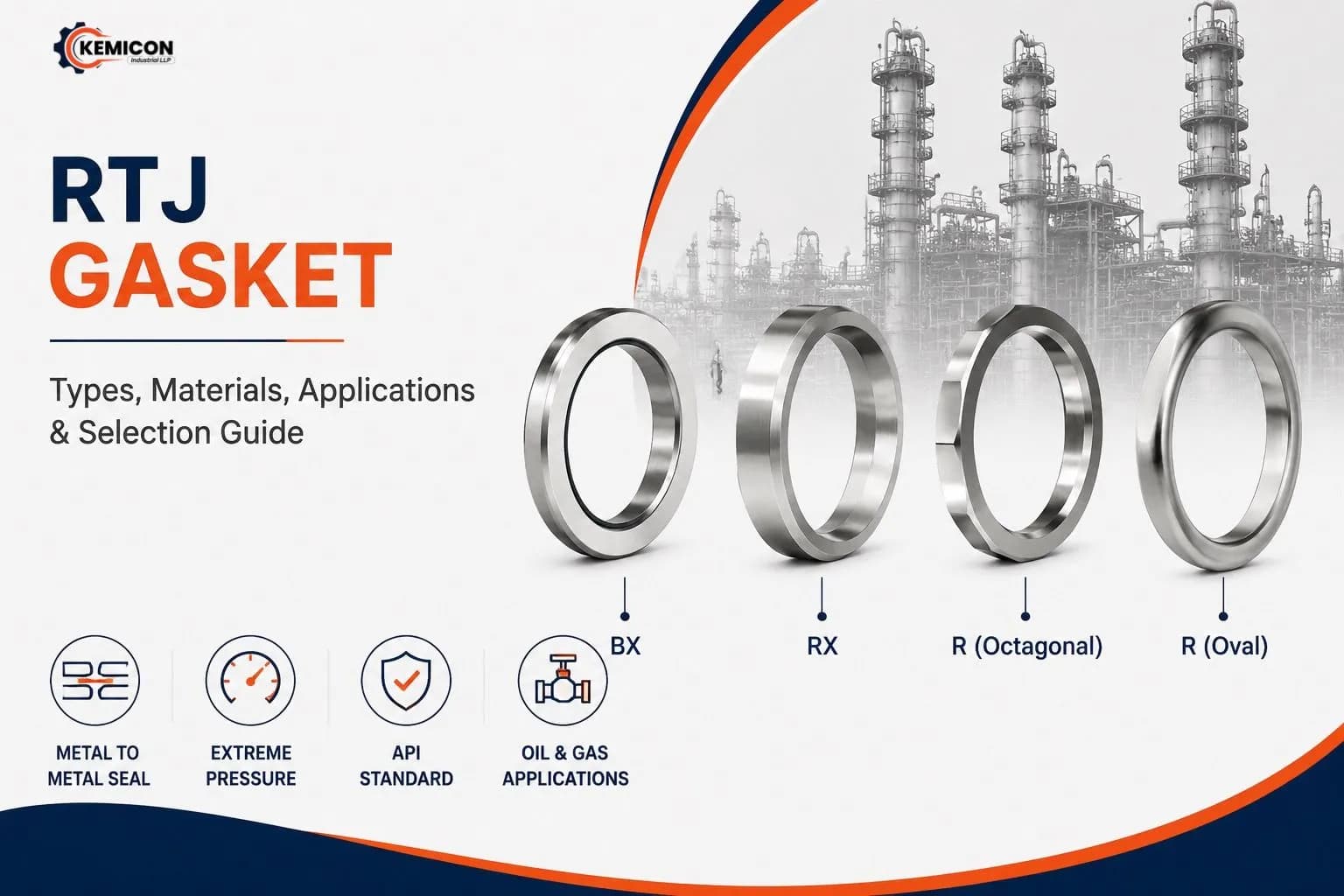
RTJ gasket profiles are defined by ASME B16.20 and API standards. Selecting the correct profile is essential — a mismatch between gasket geometry and flange groove will not seal, regardless of material quality.
R Oval RTJ gasket
The R Oval profile is one of the oldest and most widely used RTJ gasket designs. Its elliptical cross-section is compatible with both oval and octagonal grooves on legacy flange designs, making it common in existing refinery and plant installations.
R Oval gaskets suit standard pressure applications, retrofit projects, and older equipment where the flange groove was originally cut for an oval profile.
R Octagonal RTJ gasket
The R Octagonal profile offers a larger sealing contact area than the oval design, resulting in improved sealing efficiency and better stress distribution across the groove.
R Octagonal gaskets are preferred for new installations and demanding industrial services where maximum contact pressure and sealing performance are required. They must be paired with octagonal grooves — they cannot substitute for oval gaskets in oval grooves.
RX RTJ gasket
RX gaskets are engineered for higher-pressure API flanges. Their cross-section includes a pressure-energised geometry that increases sealing efficiency as internal pressure rises — the ring is pushed further into the groove under system pressure.
RX profiles are specified for oil and gas wellhead equipment, offshore drilling systems, high-pressure valves, and API 6A-rated service where standard R-series gaskets cannot meet the pressure rating.
BX RTJ gasket
BX gaskets are designed for very high-pressure systems and require dedicated BX flanges with matching BX grooves. They are used in API-rated high-pressure services where no other RTJ profile provides adequate sealing margin.
BX gaskets cannot be substituted for R or RX profiles. Always confirm the flange groove designation before ordering.
Materials used in RTJ gaskets
Material selection determines corrosion resistance, hardness, and service life. The ring must be softer than the flange groove so it yields and seals without damaging the groove — a fundamental principle of RTJ gasket design.
- Soft Iron — low-cost, single-use service; galvanic coating prevents rust before installation
- Low Carbon Steel — general industrial applications
- Stainless Steel 304 — standard corrosion-resistant grade for process piping
- Stainless Steel 316 — chloride and sour service environments
- Duplex / Super Duplex — high strength with superior chloride resistance
- Inconel — extreme temperature and severe corrosion duty
- Monel — hydrofluoric acid and seawater applications
- Hastelloy — highly aggressive chemical and acid service
RTJ gasket standards
High-quality RTJ gaskets are manufactured to internationally recognised standards that govern dimensions, tolerances, materials, hardness, and marking. Following the correct standard ensures compatibility with mating flanges and predictable sealing performance.
- ASME B16.20 — primary standard for RTJ ring dimensions, tolerances, and marking
- ASME B16.5 — flange dimensions and pressure classes paired with R-series gaskets
- API 6A — wellhead and Christmas tree equipment requirements
- API 17D — subsea wellhead and tree equipment (where applicable)
- DIN standards — European flange and gasket configurations (application dependent)
Advantages of RTJ gaskets
RTJ gaskets are the preferred seal for critical high-pressure applications because they deliver performance that soft and semi-metallic gaskets cannot match in RTJ flange service.
- Metal-to-metal sealing with no soft filler to degrade or extrude
- Excellent sealing reliability under extreme pressure and temperature
- High resistance to blowout in properly rated flange systems
- Strong performance under vibration and thermal cycling
- Long service life when correctly specified and installed
- Wide range of corrosion-resistant alloy options
- Suitable for hazardous and sour process fluids (with correct material grade)
- Available in standard ASME/API sizes and fully custom dimensions
Industries that use RTJ gaskets
RTJ gaskets are specified wherever safety, sealing performance, and regulatory compliance are critical. Common industries and applications include:
- Oil and gas — pipelines, wellheads, manifolds, and valve bonnets
- Petrochemical and refining — reactors, distillation columns, and transfer lines
- Offshore platforms and subsea equipment
- LNG plants — cryogenic and high-pressure process lines
- Power generation — high-pressure steam and boiler connections
- Chemical processing — pressure vessels and reactor flanges
- Marine — engine room and cargo handling systems
- Pipeline infrastructure — compressor stations and metering skids
How to choose the right RTJ gasket
Selecting the wrong RTJ profile or material grade is a common cause of flange leaks in high-pressure service. Confirm every item below before placing an order.
- Pressure rating — higher pressure systems typically require RX or BX profiles
- Operating temperature — minimum and maximum; confirm material limits
- Process media — sour service, chlorides, or HF may require Inconel, Monel, or 316 SS
- Flange groove type — oval, octagonal, RX, or BX; must match gasket profile exactly
- Flange standard — ASME B16.5, API 6A, or project-specific specification
- Pipe size (NPS) and pressure class
- Material certification — EN 10204 3.1 MTR, NACE MR0175, or API monogram requirements
- Reuse policy — replace gaskets after opening critical joints; do not reuse in high-pressure service
RTJ gasket vs spiral wound gasket
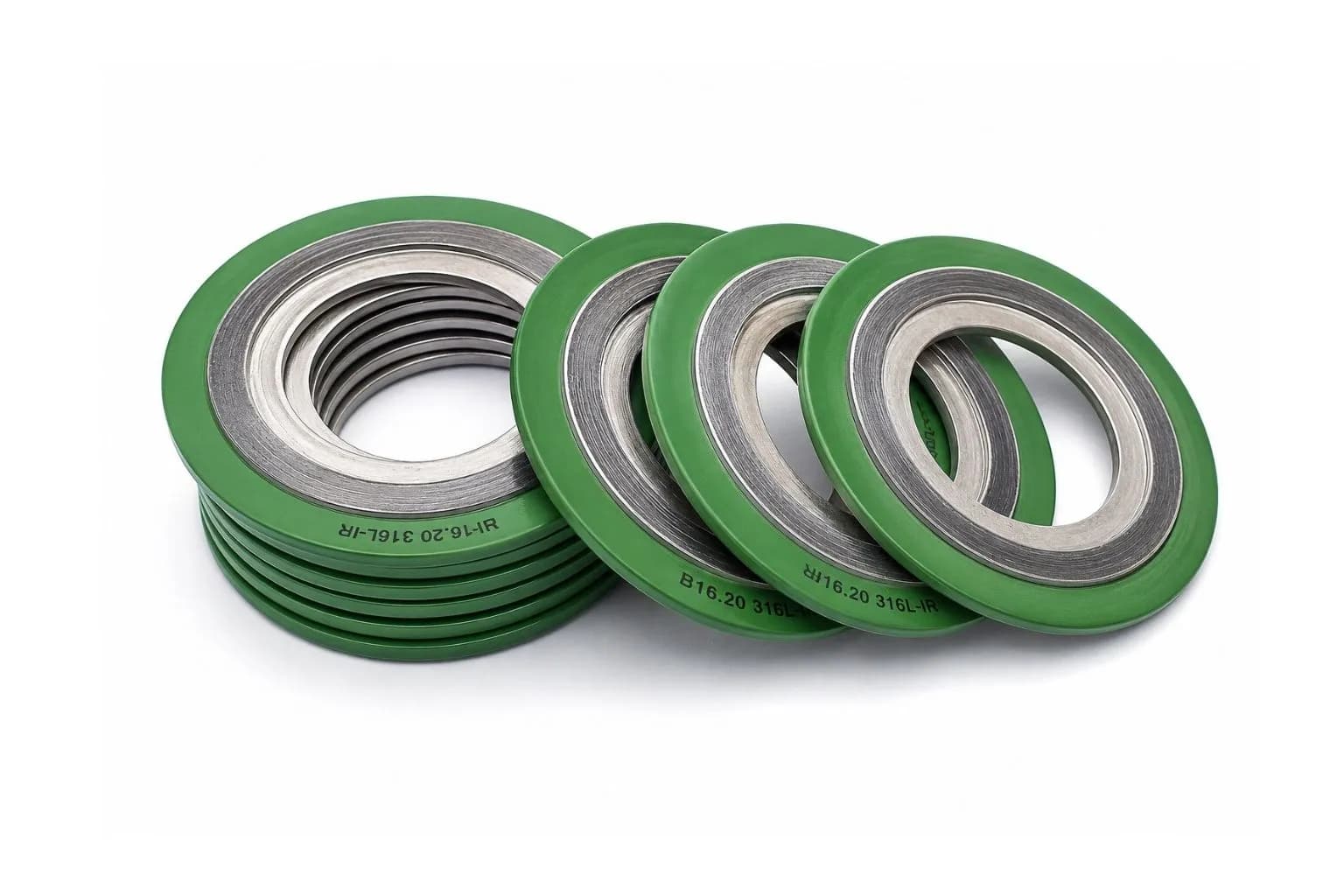
RTJ and spiral wound gaskets are both widely used in industrial sealing, but they are designed for fundamentally different flange types and operating conditions. An RTJ gasket requires a ring groove flange; a spiral wound gasket seals on raised-face or flat-face flanges with a soft filler component.
For a detailed comparison of spiral wound construction, filler selection, and raised-face applications, see our Complete Guide to Spiral Wound Gaskets.
Why specify Kemicon for RTJ gaskets
RTJ gasket performance depends on precise CNC machining, correct metal hardness relative to the flange groove, and full material traceability — none of which is visible once the flange is closed.
Kemicon Industrial LLP manufactures RTJ gaskets to ASME B16.20 and API specifications with premium certified metals, precision machining, strict dimensional inspection, and Material Test Reports on request. Standard catalogue sizes and fully custom dimensions are available for R, RX, and BX profiles.
Share your flange standard, groove type, NPS, pressure class, operating conditions, and certification requirements — our engineering team will confirm the correct profile and material grade before manufacture.
Quick recommendations
- Standard refinery piping (R flange)R Octagonal — SS 316
- Legacy oval groove flangesR Oval — match existing grade
- API 6A wellhead / high pressureRX profile — Inconel or SS 316
- Very high-pressure BX flangeBX profile — project-specified alloy
- Sour / NACE serviceSS 316, Inconel, or Monel — NACE MR0175
Frequently asked questions
What does RTJ stand for?
What is an RTJ gasket used for?
What is the difference between R Oval and R Octagonal RTJ gaskets?
What are RX and BX RTJ gaskets?
Can RTJ gaskets be reused?
Which materials are available for RTJ gaskets?
Which industries commonly use RTJ gaskets?
Can RTJ gaskets be manufactured in custom sizes?
Still unsure which specification fits?
Talk to our gasket engineer. Share medium, temperature, pressure class, and flange standard - we will recommend the right construction.